
Start Writing Online as a Developer: 2 Proven Paths To Accelerate Your Career and Launch a Six-Figure Writing Business
How smart developers are doubling their income in a time of uncertainty and layoffs


Most developers are terrified of writing online.
Back in 2019, I was one of them.
But here's the worst thing that could happen: Writing online will make you learn faster and understand concepts more deeply. In other words, you become better at your job.
The best case?
You establish connections with CEOs and decision makers in your niche, grow an email list of thousands, and earn premium rates ($2,000+ per article) by ghostwriting for companies you care about.
It's a win either way.
In this article, I'll show you two paths you can take to start writing online:
Write for the sake of advancing your career
Write to build a six-figure side business while still working 9-5
In the end, you'll see how #1 leads to #2.
Path #1: Write Online To Advance Your Career
When you share what you're learning and building online, you create credibility.
Let's compare two developers:
Developer 1: Has "FastAPI" keyword in resume and LinkedIn
Developer 2: Everything Developer 1 has + a published article titled "How I Deployed a 100K Views/Month Python FastAPI Application to Kubernetes (3 Mistakes To Avoid)."
One shows you think you know the technology. The other shows you've solved a real-world problem.
Which developer would you rather be?
Writing online also accelerates your learning, much faster than any course or tutorial.
When you explain concepts to others, you spot gaps in your knowledge. You can't fake understanding. This forces you to go deeper, research edge cases, become a go-to expert in your stack.
Meanwhile, your peers are still googling the same problems over and over.
Writing online positions you as a problem solver who can communicate clearly. Recruiters and CTOs can see exactly how you approach challenges and transition from problems to solutions.
Proof you can communicate clearly is proof you can be trusted managing people.
So how do you actually start?
Start writing online and publish your first article this week
If I were to start from scratch, I'd pick a platform with an active audience.
Substack or Medium are best places to start since they have millions of readers. Just don't start a blog on Wordpress. It'll take you years to get anywhere.
Write about what you actually do as a developer.
Stay away from broad overviews or "Introduction to FastAPI" posts.
Write articles that solve specific problems. The developer who googles "FastAPI SSL certificate" wants a targeted solution, not a broad guide in which they have to do all the guesswork.
Individual articles build trust because you're solving a single, focused problem.
You also need volume - readers want to see a library of content, not someone who started writing yesterday.
How many articles do you need before seeing career impact?
Some developers see job offers within 3-6 months. But that's impossible to predict. Your chances improve with every article you publish.
Writing online is a game.
The more time you play, the higher your chances are to win.
Path #2: Write Online To Build a Side Business
You already have the technical knowledge - why not help others and monetize every step of the way?
This path requires more upfront work than the first one.
You'll need a solid portfolio of published articles before clients take you seriously. Clients won't find you at all if you have 7 articles published, and you won't have much leverage when you reach out to them.
Build the portfolio first. Monetize second.
Once you have that foundation, opportunities come your way. Developers who are great at their work and can communicate clearly are unicorn-rare.
Companies pay premium rates for that combination.
Here are the two main ways to start earning as a developer:
Platform-based monetization: Publish on platforms that pay writers directly. Substack lets you build an email list and monetize through subscription-only newsletter. Medium's Partner Program pays you for every article based on reader engagement. Once you have an audience, double down with books or courses.
Client-based services: Ghostwrite for executives, companies, and publications. That CEO you admire probably needs content for their company blog. SaaS businesses always need more content because that's how they drive signups. Tech publications need writers to drive traffic and earn ad/sponsor revenue.
Ghostwriting is a premium service.
You can charge $300 to $2,000+ per article.
Pricing comes down to supply and demand - how many other developers can solve the specific problem you're solving for that specific industry?
How to monetize your writing if you're just starting out
Build a portfolio of 20-30 articles over the next 3-6 months before pitching anyone.
This isn't just about proving you can write - it's about proving you can write consistently about topics that matter to your target clients.
Quality beats quantity, but you need enough volume to show you mean business.
If you're solving problems for a specific-enough industry, clients will reach out first.
That developer who writes exclusively about governance in AI becomes the obvious choice when those companies need content.
Be present on the platforms your target clients use.
LinkedIn is usually your best bet. You don't have to post there at all - just make it easy for people to find and contact you.
Add a link to your LinkedIn profile at the bottom of every article, and make it crystal clear you're open for work and have something valuable to offer.
How #1 Leads To #2 (My Personal Story)
To get to path #2, you'll need to be actively involved in path #1 first.
I started writing on Medium in August 2019 with one goal: get my name out there and become the first person people think of when they want to learn data science.
I wrote 2-3 articles per week, every week.
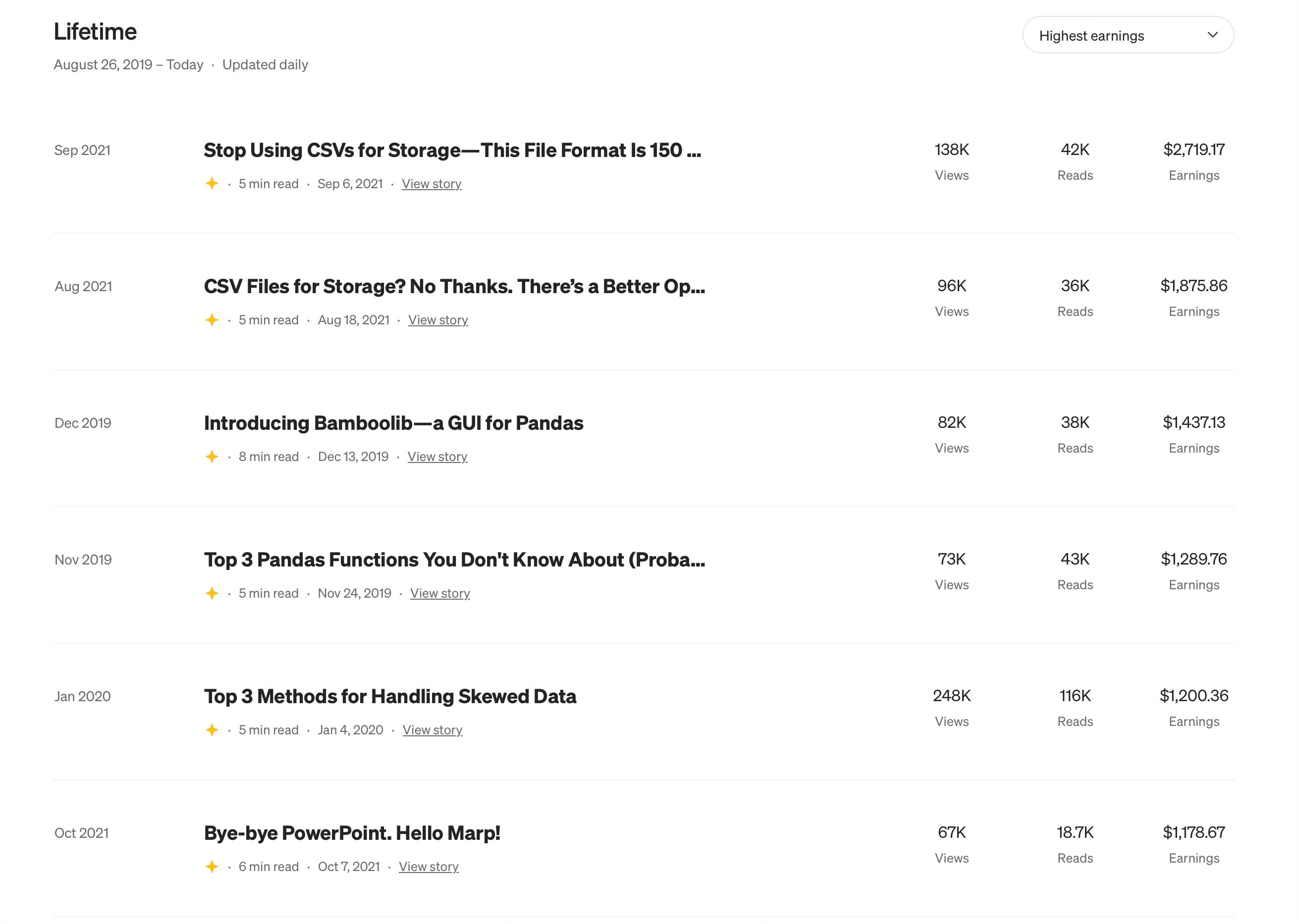
Medium was a success. I published 444 articles to date, got 50K+ followers, and accumulated over 10M views.
It was a great platform to earn, too:
6 months after my first Medium article, I landed my first ghostwriting client.
I've been working with them ever since.
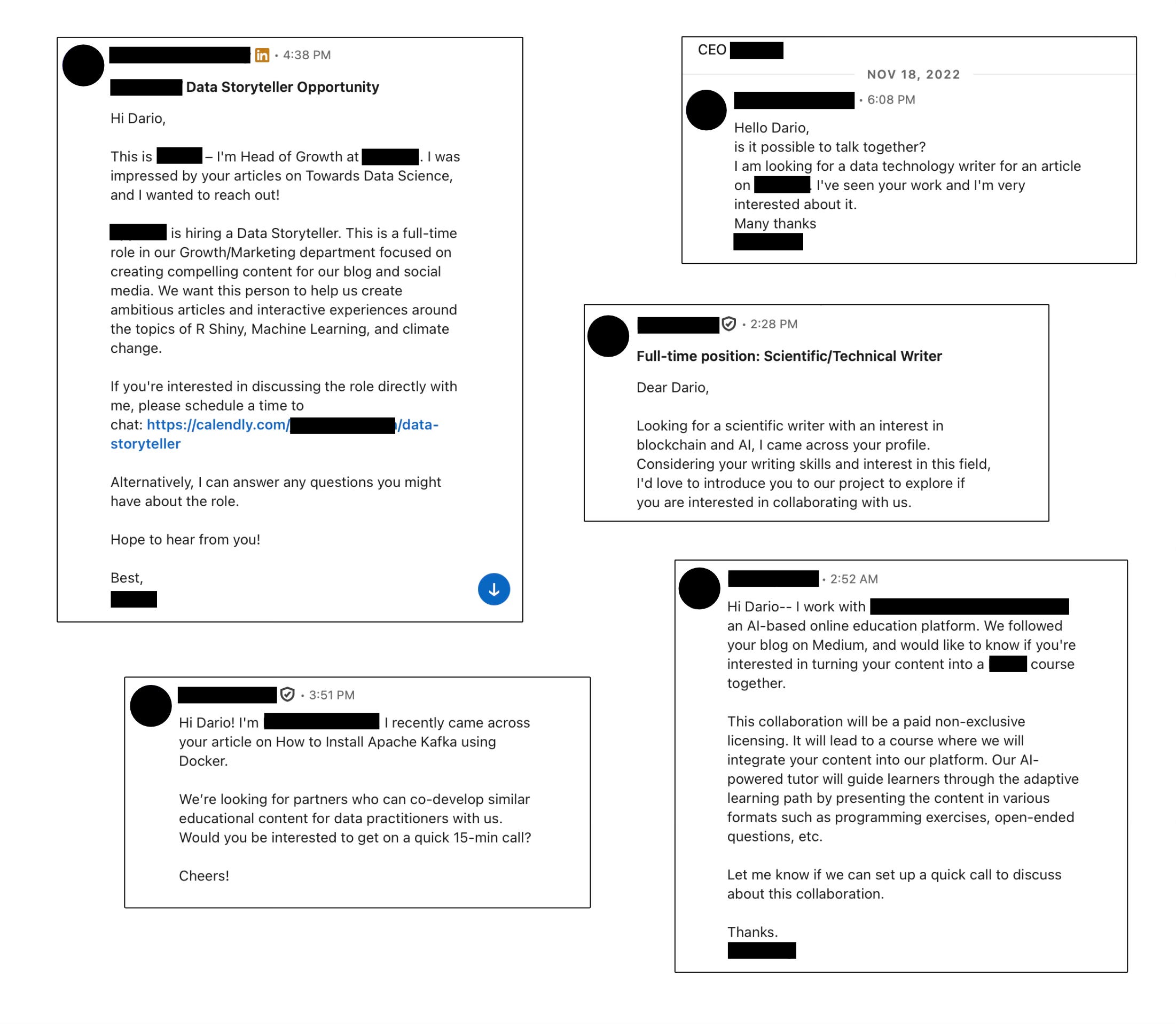
The best part? They reached out to me. This happened only because I had a strong presence on Medium.
Messages like these have become a new normal:
I've worked with more than 15 clients since then.
Some needed just a couple of articles, others became long-term collaborations with monthly retainers.
I maintained my full-time data science job and continued writing on Medium (now Substack) the entire time.
Luck had nothing to do with it:
I'm just a regular guy from a small town in Europe
I had no training in writing, which shows in my early pieces
I started from scratch with zero connections, brute-force changed all my faulty beliefs, and kept going
Waking up at 4AM every morning did the trick.
I was at it every day before work. And after work. Code one day, write the next day. Even when I wasn't seeing results - especially then.
Literally anyone can replicate what I did.
I still have no formal training in writing or marketing, but I invest a couple of hours every week to get better at it.
Six years later, writing brings more income than my day job.
Your Next Move - Start Writing Online Today
Writing online is the lowest-risk, highest-reward move you can make as a developer.
Nothing bad can happen.
At worst, you'll become better at what you do. At best, you'll build a business that doubles your salary.
Here's how I'd start today if I were in your shoes:
Start with Substack so you collect emails from day one (own your audience)
Repost on Medium to get more traffic and rank on Google
Build a solid portfolio of 20-30 relevant articles before you start pitching clients
Start pitching clients, or ideally, watch them reach out to you
Nothing more to it.
Talk soon,